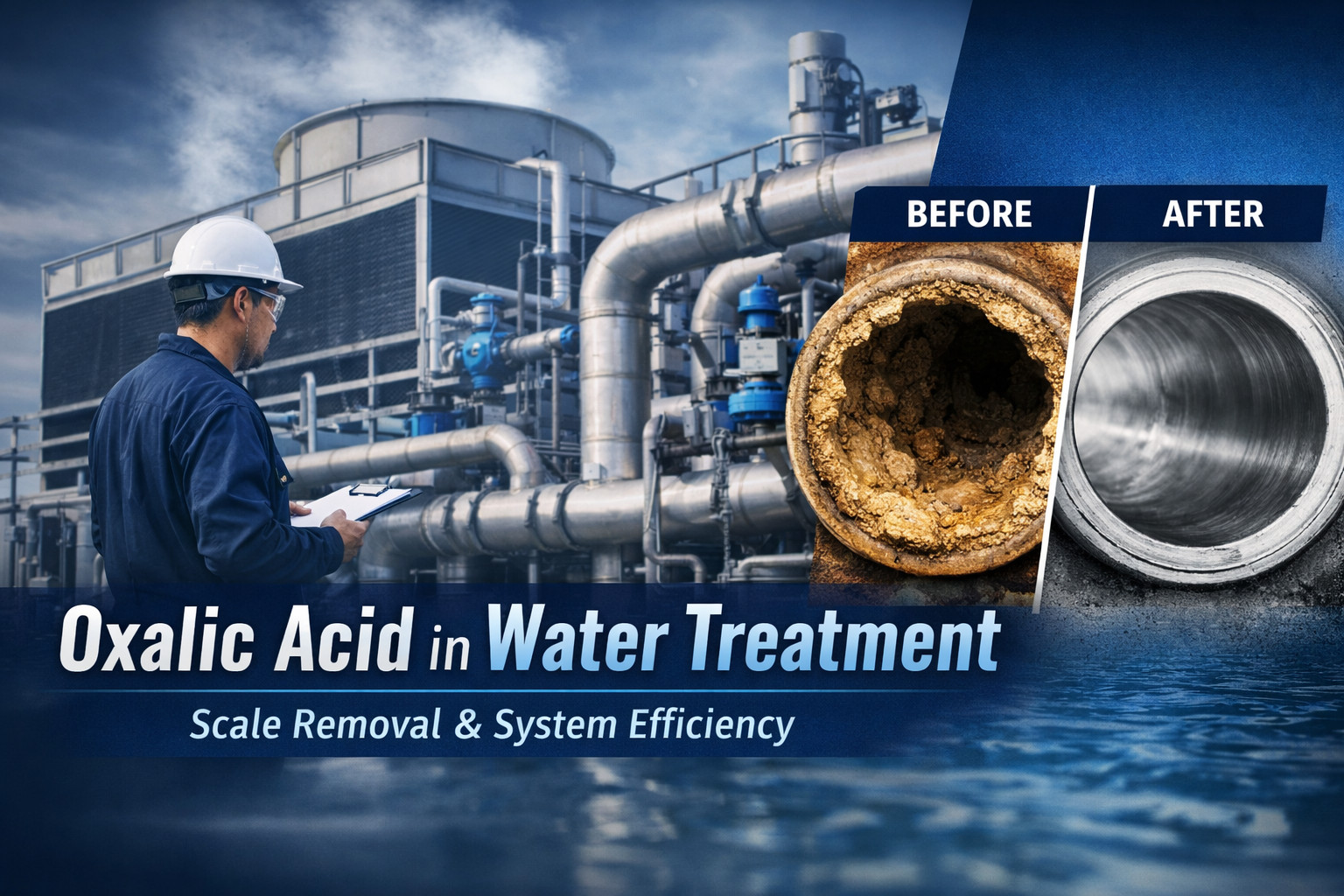
In industrial water treatment systems, efficiency is everything. Whether you’re managing a cooling tower, boiler, or closed-loop system, even small amounts of scale buildup can lead to major performance issues, increased energy costs, and long-term equipment damage.
One of the most effective and targeted solutions for addressing these challenges is oxalic acid.
Widely used across industrial water treatment applications, oxalic acid plays a critical role in removing iron-based scale, dissolving mineral buildup, and restoring system efficiency. When used correctly, it can significantly extend the life of your equipment while reducing maintenance costs and downtime.
If you’re looking for a proven solution to improve system performance, understanding how oxalic acid works — and where it fits into your water treatment strategy — is key.
👉 Explore product specifications and ordering options on our Oxalic Acid product page.
What Causes Scale in Water Treatment Systems?
Scale forms when dissolved minerals in water — primarily calcium, magnesium, and iron — begin to precipitate and accumulate on system surfaces. This is especially common in systems exposed to:
- Hard water conditions
- High temperatures (boilers, heat exchangers)
- Evaporation cycles (cooling towers)
- Poor water chemistry control
Over time, this buildup creates a dense layer of deposits that restrict system performance.
Why Scale Is a Problem
Unchecked scale can lead to:
- Reduced heat transfer efficiency
- Increased energy consumption
- Restricted water flow and pressure issues
- Accelerated corrosion and equipment wear
- Unexpected downtime and costly repairs
In fact, even a thin layer of scale can reduce heat transfer efficiency by 10–20%, making it one of the most expensive hidden issues in industrial systems.
What Is Oxalic Acid and Why Is It Effective?
Oxalic acid is a naturally occurring organic acid that is highly effective as both a chelating agent and a reducing agent.
In simple terms, this means it can:
- Bind to metal ions like iron
- Break down rust (iron oxide)
- Dissolve stubborn mineral deposits
This dual-action capability makes oxalic acid especially useful in water treatment applications where iron-based scale and corrosion are present.
Unlike some harsher acids, oxalic acid provides a more targeted cleaning approach, making it effective without being overly aggressive on system materials when used properly.
How Oxalic Acid Works in Water Treatment Systems
In industrial systems, oxalic acid is typically introduced as part of a chemical cleaning or descaling process.
Here’s how it works:
- Circulation Through the System
The solution is circulated through pipes, heat exchangers, or equipment. - Chemical Reaction with Scale
Oxalic acid reacts with iron deposits and mineral buildup, breaking them down at a molecular level. - Dissolution of Deposits
The scale becomes soluble and can be flushed out of the system. - System Rinse and Neutralization
After treatment, the system is thoroughly flushed to remove residues and restore proper water chemistry.
This process allows for deep cleaning without mechanical scraping, reducing labor and minimizing risk to equipment.
Key Applications of Oxalic Acid in Water Treatment
1. Cooling Tower Cleaning
Cooling towers are highly susceptible to scale buildup due to constant evaporation and concentration of minerals.
Oxalic acid is used to:
- Remove scale from internal surfaces and basins
- Restore efficient heat exchange
- Improve water circulation and flow
- Reduce strain on pumps and system components
Regular cleaning with oxalic acid can dramatically improve cooling tower performance and reduce energy costs.
2. Boiler and Heat Exchanger Descaling
Boilers and heat exchangers are particularly sensitive to scale buildup because they rely on efficient heat transfer.
Even minimal scaling can result in:
- Higher fuel consumption
- Reduced output efficiency
- Increased operating costs
Oxalic acid helps:
- Improve overall system performance
- Dissolve iron and mineral deposits
- Restore thermal conductivity
3. Closed-Loop System Maintenance
Closed-loop systems are designed to be stable, but over time, contaminants and corrosion products can still accumulate.
Oxalic acid supports:
- Extended equipment lifespan
- Removal of sludge and deposits
- Prevention of long-term buildup
- Improved system reliability
4. Pipe and Equipment Cleaning
Beyond major systems, oxalic acid is also used for:
- Cleaning process piping
- Removing rust from equipment
- Restoring flow efficiency
This is especially valuable in older systems where buildup has accumulated over time.
Benefits of Using Oxalic Acid in Water Treatment
Using oxalic acid as part of your water treatment strategy offers several advantages:
1. Highly Effective on Iron-Based Scale
Oxalic acid is particularly strong against iron deposits and rust, making it ideal for systems experiencing corrosion-related buildup.
2. Improves Energy Efficiency
By removing insulating scale layers, systems can transfer heat more efficiently, reducing energy consumption.
3. Reduces Maintenance Costs
Routine chemical cleaning helps prevent major repairs and extends equipment lifespan.
4. Minimizes Downtime
Faster, more effective cleaning means less disruption to operations.
5. Cost-Effective Solution
Compared to equipment replacement or extensive mechanical cleaning, oxalic acid is a highly economical option.
Best Practices for Using Oxalic Acid
To maximize results and protect your system, follow these best practices:
- Use proper dilution ratios based on system size and severity of buildup
- Circulate the solution evenly throughout the system
- Monitor pH and system conditions during treatment
- Thoroughly flush and neutralize after cleaning
- Always follow manufacturer and SDS guidelines
Working with an experienced water treatment provider ensures optimal results and safe application.
Safety Considerations
While oxalic acid is highly effective, it must be handled with care:
- Wear appropriate PPE (gloves, goggles, protective clothing)
- Avoid direct skin or eye contact
- Use in well-ventilated areas
- Store and handle according to SDS recommendations
Proper handling ensures both operator safety and system integrity.
When Should You Use Oxalic Acid?
Oxalic acid is the right choice when:
- Iron-based scale or rust is present
- System efficiency has noticeably declined
- Equipment shows signs of buildup or corrosion
- Preventative maintenance is needed
For systems with mixed scaling (calcium + iron), a combined or staged treatment approach may be recommended.
Conclusion: A Smarter Approach to Water System Maintenance
Scale buildup is inevitable in industrial water systems — but inefficiency, damage, and downtime don’t have to be.
Oxalic acid provides a powerful, targeted solution for removing deposits, restoring performance, and protecting critical equipment.
When used as part of a proactive water treatment strategy, it can help:
- Extend system lifespan
- Improve operational efficiency
- Reduce long-term costs
Explore our Oxalic Acid solutions to find the right product for your system and application.
FAQs
What types of scale does oxalic acid remove best?
Oxalic acid is especially effective at removing iron-based scale and rust deposits.
Is oxalic acid safe for water treatment systems?
Yes, when used properly and followed by thorough flushing and neutralization.
Can oxalic acid be used in cooling towers and boilers?
Yes, it is commonly used in both applications for cleaning and descaling.
How often should systems be cleaned?
This depends on water quality and system usage, but regular maintenance improves performance and longevity.